

In MBTI, INTJs are called the “Architect” type — a personality characterized by original, strategic thinking. This article analyzes the characteristics of INTJs and explains what kinds of jobs are suited to making the most of their strengths.
By deeply understanding your own personality and thinking about your career plan, we will explore what kinds of job types are appropriate, citing specific occupations along the way.
\ 30秒で完了! /
What Is INTJ (The Architect)? A Breakdown of Their Basic Personality
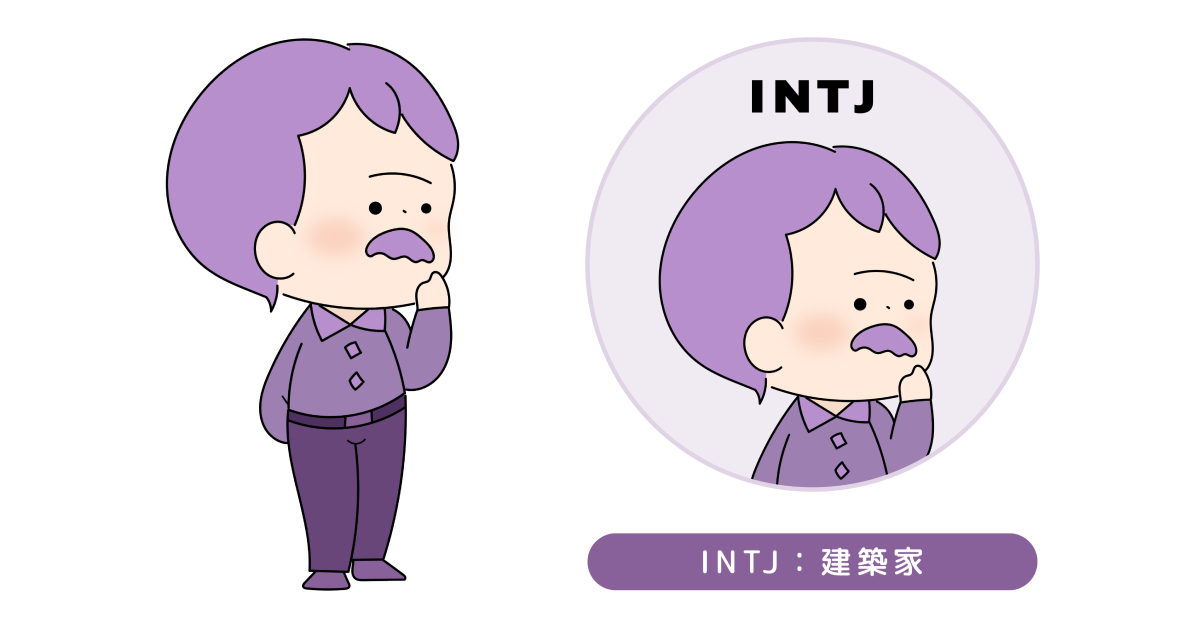
INTJ (The Architect) is one of the MBTI types, composed of four indicators: “Introverted (I),” “Intuitive (N),” “Thinking (T),” and “Judging (J).”
They have strong intellectual curiosity and excel at forming strategies for complex problems with a long-term perspective. While they possess the insight to see through to the essence of things and a strong will to achieve their goals, they also have an independent streak that dislikes familiarity with others.
Even within the same INTJ type, there are differences between INTJ-A, who tends to be assertive and self-confident, and INTJ-T, who tends to be cautious and perfectionistic.
\ 転職エージェントがご相談に乗ります /
4 Strengths of the INTJ (The Architect)

INTJ (The Architect) has the following four strengths.
- Ability to build long-term strategies
- Combines decisiveness with execution ability
- High intellectual curiosity
- Strong at logical thinking
Let’s look at how each of these strengths is useful in the workplace.
Ability to Build Long-Term Strategies
Because INTJs (The Architect) excel at deeply understanding the essence of things and viewing complex problems in a structured way, they are outstanding in their ability to build strategies from a long-term perspective.
For this reason, they are well-suited to careers such as management and strategy consultant, or project manager.
The ability to build strategies is an extremely important strength for leading an organization to success, particularly in today’s rapidly changing society.
Combines Decisiveness with Execution Ability
INTJs (The Architect) have a strong will to steadily move toward a goal once it has been set. Because they possess judgment grounded in logic, they are capable of swift and accurate decision-making even in complex situations. Even in situations where many people would hesitate, INTJs can calmly analyze the situation and identify the optimal option.
Furthermore, because they also possess the drive to put decisions into action, they excel at advancing projects while bringing others on board.
For example, they have the qualities to consistently lead the entire process — from setting concrete goals to execution and success — in endeavors such as launching a new business or improving an existing system. As a result, they will be able to fully demonstrate their abilities in situations that call for leadership and when faced with difficult challenges.
High Intellectual Curiosity
The intellectual curiosity of INTJs (The Architect) is the source of their drive and connects to a deep spirit of inquiry. Because they take strong pleasure in absorbing new knowledge and unraveling complex problems, an environment where they can continue to learn is ideal.
For example, in a research and development role in cutting-edge technology, their spirit of inquiry into unsolved matters can potentially lead to innovative discoveries and inventions. Similarly, as a researcher in an academic field, deeply drilling into a specific theme and constructing new theories would also satisfy their intellectual curiosity.
The insight to analyze information from multiple angles and see through to its essence becomes a particular strength in fields that demand specialized knowledge.
Strong at Logical Thinking
INTJs (The Architect) excel at making objective, logical judgments based on facts without being swept away by emotions.
For example, in business management decision-making, they can derive the optimal strategy based on data and logical analysis without being swayed by emotional factors or personal relationships.
Logical thinking ability becomes a major strength for responding calmly and making accurate judgments when faced with high-urgency situations or complex problems.
【募集中のコンサルタント求人】
The article was not found.
3 Weaknesses INTJs (The Architect) Should Be Aware Of

While INTJs (The Architect) have outstanding talents, they also possess some weaknesses. Understanding these weaknesses and dealing with them appropriately will lead to building smoother interpersonal relationships and improving work performance.
Difficulty Considering Others’ Emotions
Because INTJs (The Architect) place importance on logical thinking, they tend to struggle with reading others’ emotions or demonstrating empathy. As a result, they are likely to feel stress in situations that require emotional support or in environments where interpersonal relationships are highly valued.
For example, when a colleague is dealing with an emotional problem, INTJs tend to try to offer a rational solution rather than empathy. However, if what the other person is seeking is empathy and not a solution, the INTJ’s behavior may be perceived as “cold.”
These kinds of communication mismatches can generate misunderstandings, particularly in workplaces where teamwork is highly valued, and can become a barrier to maintaining smooth relationships.
In addition, INTJs tend to feel uncomfortable in customer service roles that require consideration of the other party’s emotions, so career choices that take this into account are important.
Risk of Being Perceived as Arrogant
INTJs (The Architect) have absolute confidence in their knowledge and abilities. As a result, they may sometimes adopt an attitude of not accepting others’ opinions, or of refusing to budge from their own views as the only correct answer.
In particular, because they are skilled at logical thinking, they tend to be uncomfortable with emotional arguments and may strongly rebut opinions that are not based on facts or data.
Such behavior and speech can give those around them the impression of being “arrogant” or “not listening to others’ opinions,” and can potentially cause rifts in relationships.
Holding Others to High Standards
Because INTJs (The Architect) tend to set high standards for themselves, they may unconsciously demand the same level from others. While this characteristic can act positively as a strong commitment to improving project quality and achieving goals, it also harbors the potential to create friction with those around them.
For example, when collaborating on a team task, INTJs may expect perfect performance from each team member, and if they feel anyone falls even slightly short of the standard, they may become dissatisfied or render harsh evaluations. While this kind of attitude is behavior that arises from INTJs’ own pursuit of high results, it may be perceived by others as “inflexible” or “demanding,” and can become a cause of rifts in relationships.
In particular, if they impose their own standards without considering differences in others’ abilities and motivation, this can lead to lowering the morale of the entire team.
\ 転職エージェントがご相談に乗ります /
13 Ideal Jobs for INTJs (The Architect)

The INTJ (The Architect) type, due to its characteristics, demonstrates high performance in certain professions. Here, we carefully select and introduce 13 ideal jobs for INTJs.
Consultant
Consultants play a role in deriving solutions to the challenges companies face through specialized knowledge and logical thinking. INTJs’ (The Architect) strengths of “long-term strategic thinking” and “decisiveness and execution ability” are greatly utilized in the consulting industry.
For example, in formulating a client company’s management strategy, they deeply analyze the current situation from multiple perspectives — from market analysis and competitive research to evaluating the company’s own strengths and weaknesses. On top of this, they are required to propose concrete business plans and organizational reform proposals and support their execution.
Because INTJs excel at the work of structurally organizing complex information and presenting logically based optimal solutions, they are well-positioned to play a central role in solving corporate challenges.
In addition, consultants have many opportunities to encounter the challenges of diverse industries and companies, and the fact that they can deepen their expertise while satisfying their intellectual curiosity is also a major attraction for INTJs. Since it is an environment where results are clearly evaluated, they will be able to maximize their abilities and work while experiencing a sense of achievement.
\ 30秒で完了! /
Corporate Planning
Corporate planning is an important job type responsible for formulating and executing a company’s long-term growth strategy and business plans.
Specific duties include identifying new business opportunities through market research and competitive analysis, examining M&A strategies, formulating plans for launching new businesses, and drawing up budgets, among a wide range of other tasks. INTJs’ (The Architect) ability to build strategies from a long-term perspective is a particularly strong asset in corporate planning, which has the power to determine the future of a company.
For example, in a rapidly changing market environment, tasks such as reconstructing a business portfolio with several years of foresight or formulating drastic reform plans to improve the profitability of existing businesses are areas where INTJs excel. Furthermore, logical thinking and analytical ability are indispensable for accurately grasping the current situation from vast amounts of data and making management decisions based on objective evidence.
For INTJs, who are highly independent and prefer to tackle problems autonomously, this role — which involves closely collaborating with senior management to support decision-making on matters fundamental to the company — will offer a strong sense of purpose. The process of seeing their own ideas and analysis results materialize as the company’s growth strategy will also greatly stimulate their intellectual curiosity.
Business Development Planning
Business development planning is an important position that influences a company’s future, and is a role where INTJs’ (The Architect) strategic thinking and long-term vision can be fully utilized.
Specific duties include planning new businesses, formulating expansion strategies for existing businesses, and identifying business opportunities through market research and competitive analysis.
Because INTJs combine data-driven rational judgment with the tenacity to persistently pursue goal achievement even in difficult situations, they can concretize business plans and guide them to success.
For example, when planning a new service that leverages AI, INTJs would analyze not only technical feasibility but also market needs, profitability, and legal regulations from multiple angles, and formulate a detailed business plan. They would also actively create a concrete roadmap for putting that plan into action and be involved in securing the necessary resources and building the team structure.
Lawyer
A lawyer is a specialist who uses deep knowledge of the law, logical thinking, and problem-solving ability to protect the rights of clients.
The INTJ (The Architect) type excels at analyzing complex laws and regulations, seeing through to the essence of a case, and formulating the optimal strategy, making them very well-suited to being a lawyer.
For example, when identifying legal issues in a corporate M&A (merger and acquisition) and drafting contracts to minimize risk, INTJs’ meticulous analytical ability and long-term perspective are fully demonstrated.
The process of carefully untangling a client’s complex problems one by one and guiding them to resolution using the law as a tool will be a source of great fulfillment for intellectually curious INTJs.
Furthermore, the work of a lawyer is highly autonomous and can be advanced at one’s own discretion, which is consistent with the way INTJs ideally like to work. Constantly keeping up with new case law and legal revisions and continuing to deepen one’s own expertise is also a factor that stimulates intellectual curiosity.
Certified Public Accountant (CPA)
A Certified Public Accountant (CPA) is a specialist who objectively audits a company’s financial status and certifies its appropriateness. The work of analyzing a company’s complex accounting data and rigorously checking for fraud and errors will allow INTJs to fully exercise their problem-solving ability.
In addition, deeply understanding specialized knowledge such as accounting standards and tax law, and the intellectual curiosity to constantly update one’s knowledge with the latest information, is also indispensable for success as a CPA.
It is also possible to work independently, making it an attractive option for INTJs who prefer to advance work at their own pace. The process of interpreting complex regulations and logically applying them will feel full of intellectual stimulation. Furthermore, they can also engage in consulting work that involves analyzing a company’s management situation from multiple angles and making improvement proposals, allowing them to also apply their strategic thinking ability.
フリーランスの方はこちら【みらいワークス関連サービス】 \約950社以上の取引実績あり/
>> フリーランスコンサルタントのための案件紹介サービス【フリーコンサルタント.jp】
Data Scientist
Data scientist is one of the professions very well-suited to INTJs (The Architect). Data scientists are required to analyze large amounts of data and derive valuable insights from it. INTJs’ logical thinking ability and problem-solving skills are of great use when identifying patterns from complex datasets and building predictive models for the future.
For example, there is work such as analyzing trends in consumer behavior from customer purchase history data and providing insights useful for marketing strategy, or detecting anomalies from sensor data in the manufacturing industry and contributing to improvements in production efficiency. In addition, because INTJs have strong intellectual curiosity, they will find joy in constantly learning new analytical methods and programming languages and improving their own skills.
The process of using programming skills such as Python and R, and knowledge of AI technologies such as machine learning and deep learning, to discover value that no one has yet noticed brings great satisfaction to INTJs.
The work of a data scientist — deepening specialized knowledge in statistics and mathematics while logically solving challenges — can be said to be an ideal career path that fully leverages INTJ characteristics.
Marketer
A marketer is a profession that involves analyzing market trends, deeply understanding customer needs, and then planning and executing the optimal promotion strategy for products and services. It can be said to be a job type where INTJs’ (The Architect) strengths of long-term strategic thinking, intellectual curiosity, and rational thinking can be fully utilized.
For example, by conducting meticulous, data-based market research and analyzing competitors’ strategies, it is possible to plan effective advertising campaigns and develop new promotional methods.
However, in the work of a marketer, there are also situations that require frequent interpersonal communication, such as collaborating with team members and making presentations to customers. Care is needed regarding INTJs’ weakness of being poor at considering others’ emotions and the possibility of being misunderstood as arrogant.
Leveraging one’s logical thinking while also having the flexibility to listen to the opinions of those around you and pursue goal achievement collaboratively will be the key to thriving even more as a marketer.
Project Manager
A project manager plays the role of consistently directing a project from overall planning through execution, progress management, and completion. It can be said to be a job type that fully leverages INTJs’ (The Architect) strengths of long-term strategic thinking, decisiveness and execution ability, and rational thinking.
For example, in an IT development project, INTJs can grasp the big picture of a complex system construction, and by identifying tasks, necessary resources, and potential risks for each development phase in advance, they can enhance the stability of the plan.
In addition, even when unexpected problems arise, they are able to logically analyze the situation without being swayed by emotion and swiftly put the optimal solution into action. Leadership in collaborating with multiple departments and teams, managing each one’s progress, and guiding the project toward goal achievement is also one of the strengths that INTJs possess. By understanding the individuality of each team member and distributing roles appropriately, the overall efficiency of the project can be maximized.
Engineer
Engineering is one of the professions very well-suited to INTJs (The Architect). Because INTJs have strong intellectual curiosity and are skilled at logically solving complex problems, they will be able to fully demonstrate their talents in work such as system development and software design.
For example, they can work in an environment that constantly provides intellectual stimulation, such as mastering a new programming language or optimizing an existing system. Furthermore, engineering work offers many opportunities to focus and work at one’s own pace, making it a comfortable environment for INTJs who value independence.
In projects as well, they can leverage their decisiveness and execution ability to derive the optimal solution through logical thinking and put it into action. Specifically, there are many fields such as AI development engineer, data analysis engineer, and network engineer where specialization and a spirit of inquiry can be deepened.
Game Developer
Game developer is one of the professions that allows INTJs (The Architect) to fully utilize their intellectual curiosity and logical thinking ability. In particular, in the areas of game planning, system design, and programming, INTJs’ strength of analyzing complex challenges and generating original solutions is greatly demonstrated.
For example, designing AI algorithms by predicting player behavior patterns, or analyzing vast amounts of data to optimize game balance, are areas where INTJs excel.
In addition, the ability to take a bird’s-eye view of the entire project and build a development roadmap from a long-term perspective is also extremely important in game development. The attitude of constantly exploring new technologies and methods of expression and taking on unfamiliar challenges satisfies INTJs’ intellectual curiosity and leads to sustained motivation.
Furthermore, in the process of creating a single work as a team, leadership in presenting logical opinions and guiding the project in the right direction is also expected. Game development requires not just shaping ideas but also meticulous planning and execution ability to realize them, making it a profession where INTJs can find great fulfillment.
Web Designer
Web designer is a profession that allows INTJs to leverage their characteristics in logically analyzing client requirements and designing websites that are easy for users to use.
In designing user experience (UX) and user interface (UI), strategic thinking is required that predicts user behavior patterns and considers optimal information placement and operability. Because INTJs excel at organizing complex information and structuring it systematically, they can create designs that are both functional and beautiful.
For example, when designing the user flow for achieving the purpose of a website, strategic approaches such as analyzing user psychology and devising the optimal click flow are possible. In addition, the intellectual curiosity to actively learn new design tools and technologies and constantly seek to improve one’s skills will also be a major strength in the rapidly changing web industry.
The fact that there is much time for concentrated solo work and it is an environment where tasks can be advanced at one’s own pace is also attractive to INTJs, who have a strong independent streak.
Technical Writer
A technical writer is a job that involves creating text to convey specialized content clearly and accurately, such as product manuals, technical documents, and instruction guides. Because INTJs (The Architect) are skilled at logically organizing complex information and explaining it in a structured manner, they are very well-suited to technical writing.
For example, regarding a new software feature in an IT product, the ability to accurately understand the developer’s intent and explain the procedures step-by-step so that users can operate it without confusion, or to break down technical terms and explain them in plain language, is required.
In addition, because INTJs with high intellectual curiosity find joy in deeply exploring knowledge about new technologies and products, the ability to write while constantly learning the latest information is also an attraction. In document creation, they pursue objective and rational expressions that leave no room for misunderstanding, and this attention to detail leads to the creation of high-quality documentation.
Depending on the company, there may also be cases of working closely with the product development team and being involved in document creation from the development stage, with many situations where INTJs’ strategic thinking ability is leveraged. Technical writing — which demands accuracy, logical structure, and a spirit of inquiry into specialized knowledge — is one of the professions where INTJs can fully exercise their strengths.
University Professor
University professor is one of the professions very well-suited to the INTJ (The Architect) type. The role of not just transmitting knowledge but also nurturing the next generation of thinkers satisfies INTJs’ intellectual curiosity and passion for education.
In addition, through deep dialogue with students, they excel at breaking down things into logical steps and devising strategies to promote understanding, making it easy to find fulfillment as an educator. Some also note that lecture-format classes create less stress than small-group seminars, making it easier to immerse oneself in one’s own area of expertise.
However, challenges also exist, such as difficulty understanding students’ emotions and being poor at explaining routine tasks. However, the fact that it is an environment that satisfies their intellectual curiosity, allows continuous learning and deepening of specialized skills, offers a high degree of discretion, and allows for autonomous work are important factors for INTJs to succeed in the role of university professor.
\ 転職エージェントがご相談に乗ります /
3 Characteristics of Jobs Where INTJs (The Architect) May Struggle

The INTJ (The Architect) personality can sometimes be the source of difficulty in certain work environments and job content. In workplaces where their strengths cannot be leveraged, or where their weaknesses are prone to showing, they may experience significant stress. Here, we explain three characteristics common to jobs that are not suited to INTJs.
Roles Requiring Frequent Interpersonal Communication
INTJs (The Architect) have an introverted nature and tend to expend a great deal of energy on communication that lacks a clear purpose. For this reason, jobs that require frequent interaction with an unspecified number of customers — such as sales, customer service, and call center operator roles — can be a source of stress.
In particular, when building human relationships through emotional responses and small talk is the main substance of the work, it will feel painful for INTJs, who prioritize logic and efficiency. It is wise to avoid environments where dialogue itself, rather than task completion, is the purpose.
Jobs Centered on Repetitive Routine Tasks
For INTJs (The Architect), who have strong intellectual curiosity and constantly seek to acquire new knowledge and skills, routine tasks with no room for creativity are difficult to stay motivated in.
For example, data entry that involves repeating the same steps every day, factory assembly line work, or general clerical duties that require manual-based responses are situations where they are likely to feel their abilities are going to waste.
In environments where improvement and efficiency suggestions are not accepted and you simply have to perform assigned tasks, it becomes impossible to find intellectual stimulation or a sense of fulfillment. Jobs with few opportunities for growth and challenge can significantly diminish INTJs’ potential.
Workplaces Where Emotional Empathy Is Highly Valued
INTJs (The Architect) excel at making objective judgments based on facts and logic, but they are not particularly good at picking up on others’ emotions and demonstrating empathy. For this reason, in job types such as counselor, care worker, and childcare worker — where empathizing with the other person’s feelings is what is most highly valued — they may find it difficult to demonstrate their abilities.
The attitude of trying to present a rational solution can be perceived by the other party as “cold” or “not empathizing,” leading to a mismatch. In environments where emotional support is the core of the job duties, there may be many situations where both the INTJ themselves and those around them feel stressed.
【募集中のコンサルタント求人】
The article was not found.
Tips for INTJs (The Architect) to Find a Job That Suits Them

For INTJs (The Architect) to succeed in their careers and achieve high levels of satisfaction, they need to deeply understand their own characteristics before searching for a job. It is important to find not just superficial conditions such as salary and benefits, but an environment that can satisfy their inner needs.
Here, from the perspectives of self-analysis, choosing an environment, and long-term career design, we introduce three specific tips for INTJs to find a job that suits them.
Analyze Where Your Intellectual Curiosity Is Directed
The source of INTJs’ (The Architect) actions lies in their inexhaustible intellectual curiosity. For this reason, it is first indispensable to self-analyze what fields you are strongly interested in and want to explore. By looking back on experiences where you lost track of time and became absorbed in something in the past, and the genres of knowledge you learned on your own initiative, the direction of your interests will come into view.
In career choices, using whether the role can satisfy your inner spirit of inquiry as an important criterion will lead to long-term satisfaction.
Look for an Environment with a High Degree of Discretion Where You Can Work Autonomously
INTJs (The Architect), who have a strong independent streak, are extremely averse to micromanagement by supervisors. They demonstrate their best performance in an environment where they can advance their work at their own pace and choose the optimal method at their own judgment.
Therefore, when looking for a job, it is important to place emphasis on whether there is a high degree of individual discretion.
It is necessary to ask specific questions about the team’s management policy and the way individual tasks are conducted on the company’s website or in interviews, and to assess whether it is a culture that respects autonomy. The introduction of flexible working hours and remote work will also serve as one indicator of an environment where autonomous work is possible.
Consider a Career Path Where You Can Continuously Learn Specialized Skills
INTJs (The Architect) find strong value in their own growth and always want to continue deepening their expertise. In choosing a job, rather than just the current job content, it is necessary to consider from a long-term perspective what kinds of skills and knowledge can be acquired in the future through the work.
Check the comprehensiveness of the training programs the company offers, whether there is support for obtaining qualifications, and whether a path to more advanced specialist roles is open. An environment where one’s own capability development contributes to the company’s growth and that contribution is properly evaluated is what can be called the ideal workplace for INTJs.
\ 転職エージェントがご相談に乗ります /
Frequently Asked Questions About Careers Suited to INTJs

Here we have compiled frequently asked questions about INTJ careers and their answers. Please use this as a reference when thinking about your own career choices and career plan.
\ 30秒で完了! /
Summary
INTJs (The Architect), thanks to their outstanding strategic thinking and independence, are capable of achieving great results in highly specialized fields and planning roles that determine the direction of an organization.
On the other hand, repetitive routine tasks and jobs where emotional empathy is the main focus should be avoided.
Unlike types such as INFJs who place importance on empathy toward others, INTJs find joy in the pursuit of rationality. Choosing a career path that satisfies your intellectual curiosity and allows you to continually deepen your expertise will lead to greater satisfaction in your work.


