

A logic tree is a method of thinking that structurally breaks down and analyzes things in order to solve problems or achieve goals. By utilizing this way of thinking, even complex challenges can be organized, making it easier to find the essential causes and specific solutions. This article explains in an easy-to-understand manner everything from the basics of what a logic tree is, to the types useful in business settings, the benefits it provides, and a simple way to create one for beginners.
Basic Knowledge of Logic Trees | A Thinking Tool Useful for Problem-Solving

A logic tree is a thinking tool for improving the quality of problem-solving and decision-making, and is one of the basic frameworks indispensable to logical thinking.
Its main purpose lies in decomposing complex phenomena into their constituent elements and visualizing the overall picture.
By utilizing this tool, you can divide vague challenges into specific elements and logically organize where the essence of the problem lies, or what needs to be done. It is useful in various thinking situations in business.
A Logic Tree Is a Way of Thinking That Structurally Breaks Down Things
Rephrasing the definition of a logic tree, it is “a way of thinking that hierarchically decomposes a theme into its elements based on logical connections.” Its structure resembles the image of a single tree branching from a trunk into branches and then leaves.
By placing the largest theme at the apex and breaking down elements finely as you move toward the lower levels of the hierarchy, things are organized structurally.
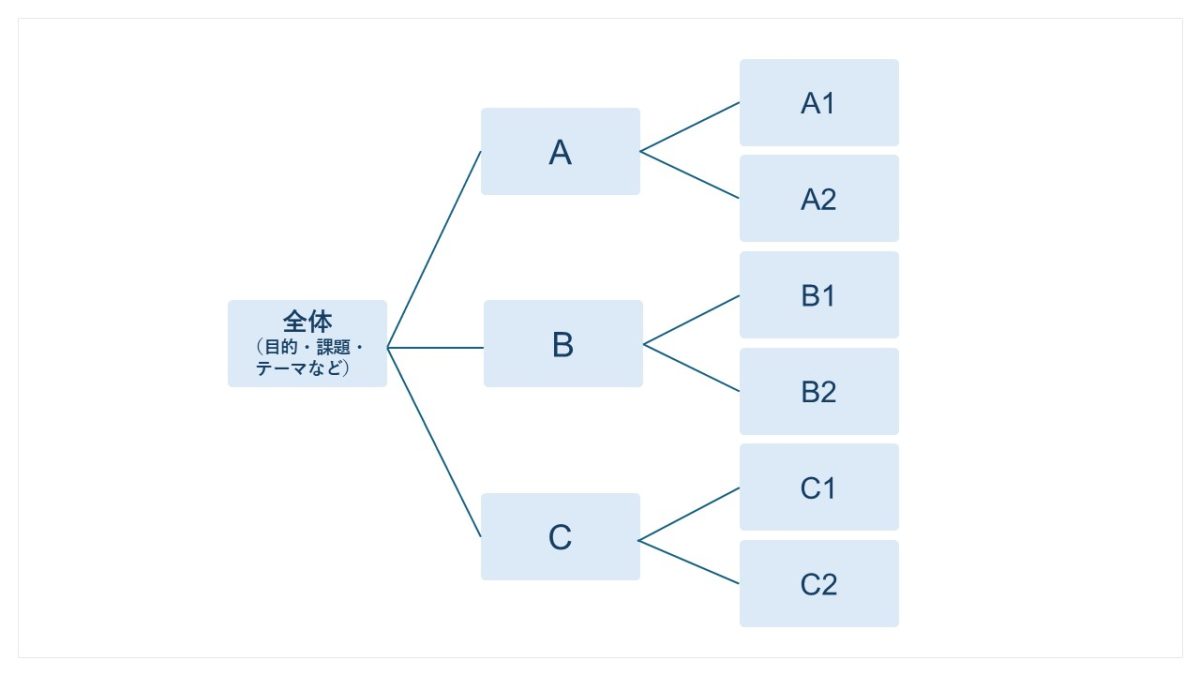
Through this process, even complex problems can be reconceived as an aggregate of small elements, which has the meaning of clarifying the relationship between each of them.
Differences from Mind Maps and Pyramid Structures
A method that is often confused with logic trees is the mind map.
The major difference between the two lies in how thinking is developed. While a mind map spreads ideas radially from a central theme through free association, a logic tree is conscious of MECE (Mutually Exclusive, Collectively Exhaustive) and decomposes elements through logical connections.
In addition, a pyramid structure is a framework for placing a conclusion at the apex and arranging its grounds in pyramid form in lower layers to demonstrate the validity of an argument.
A logic tree, on the other hand, differs in that its purpose is the decomposition and organization itself — such as drilling down into causes or identifying solutions.
[By Purpose] 4 Representative Types of Logic Trees and Specific Examples

- The “Why Tree (Cause Investigation Tree)” for identifying causes
- The “How Tree (Problem-Solving Tree)” for finding solutions
- The “What Tree (Element Decomposition Tree)” for identifying the elements that make up the whole
- The “KPI Tree” for organizing metrics for goal achievement
Logic trees come in multiple types, and it is important to use the appropriate one according to the category of challenge you want to resolve.
Since the angle of decomposition and way of asking questions differ by purpose, it is necessary to understand the characteristics of each.
Here, we explain how to use each of the four representative types commonly used in business settings, incorporating specific example topics and use cases.
The “Why Tree (Cause Investigation Tree)” for Identifying Causes
A Why Tree is a logic tree for repeatedly asking “Why?” in response to an occurring problem (issue) and drilling down to find the fundamental cause.
Also called an issue tree, it is used when comprehensively identifying multiple factors behind the surface-level phenomena, not just the surface phenomena themselves.
For example, for the problem of “a website’s bounce rate is high,” you set up the question “why is the bounce rate high?” and comprehensively decompose the possible factors.
Then, by repeating “why?” for each decomposed factor, you approach the identification of the true cause.
The “How Tree (Problem-Solving Tree)” for Finding Solutions
A How Tree is a logic tree for setting up the question “How should it be executed?” in relation to a specific challenge or goal achievement, and for identifying specific solutions and methods.
Also called a problem-solving tree, it is effective when developing abstract themes into specific action plans.
For example, for the goal of “energizing information sharing within the company,” you ask “How (in what way) to energize it?” and think of measures such as “introducing tools,” “improving regular meetings,” and “cultivating a culture.”
Each measure is then further decomposed with “How” to make it concrete to an executable level.
The “What Tree (Element Decomposition Tree)” for Identifying the Elements That Make Up the Whole
A What Tree is a logic tree for asking “What does it consist of?” about a concept or theme, and comprehensively identifying the elements that make up the whole.
Also called an element decomposition tree, it is useful when you want to structurally understand the overall picture of something.
For example, when decomposing the theme of “our company’s marketing activities,” it can be divided into elements such as “advertising,” “public relations,” “events,” and “website.”
There are no fixed rules for the angle of decomposition, but in business settings, frameworks such as 4M (Man, Machine, Material, Method) and 5W1H may also be utilized.
The “KPI Tree” for Organizing Metrics for Goal Achievement
A KPI Tree is a method for breaking down and organizing in tree form the Key Performance Indicators (KPIs) that are constituent elements toward the achievement of the final business goal (KGI). It is widely used in the fields of management and marketing.
For example, when placing the company’s final goal of “improving profits” at the apex, it can be decomposed into “increasing sales” and “reducing costs.”
Furthermore, “sales” is decomposed into indicators tied to specific actions, such as “number of customers × customer unit price.” This visualizes how daily activities such as customer acquisition through advertising contribute to the final goal.
- What Are Causal Relationships? Also Introducing the Difference from Correlations and How to Identify Causal Relationships
- What Is Critical Thinking? Also Explaining Useful Thinking Frameworks
5 Benefits Gained from Utilizing Logic Trees

The benefits of logic trees are wide-ranging, and by using them correctly, significant improvement in the quality of problem-solving and decision-making can be expected.
This thinking tool is also highly regarded as a framework not just for organizing information but for logically training the thinking process itself.
Here, we explain five specific advantages that business professionals can gain by using logic trees.
The Overall Picture of Complex Problems Can Be Visually Grasped
Even complexly entangled challenges and concerns, when broken down using a logic tree, can be visually captured in their overall picture.
Information that cannot be organized purely in one’s head becomes clear in terms of the relationship between each element when translated into a tree-structured diagram or table.
The vertical hierarchy shows causal relationships and degree of specificity, while horizontal parallel relationships comprehensively show elements at the same hierarchical level.
This allows you to objectively grasp where the bottleneck in the problem is and which elements are important.
The Root Cause of Challenges Becomes Easier to Pinpoint
By using a logic tree — particularly a Why Tree — it becomes easier to logically pinpoint the root cause of challenges without being misled by surface-level phenomena.
For example, in manufacturing, when the problem of “a certain part of a car has many defects” arises, you drill down by repeatedly asking “why are there many defects?” This allows factors such as “insufficient worker skills,” “aging machinery,” and “material quality” to be identified, and by further drilling down, the true cause can be reached.
This is a particularly effective approach in the fields of research and development and quality management.
Specific Solutions and Action Plans Can Be Derived
By utilizing a How Tree, vague goals can be broken down to the level of specific actions.
For example, suppose a sales division sets the goal of “increasing the number of contracts for a new service.” When this is decomposed with a How Tree, specific measures such as “expanding the prospect list,” “improving approach methods,” and “reviewing proposal materials” are derived.
By advancing the decomposition further, the tasks and to-dos to work on starting tomorrow become clear, and the ability to execute work increases.
The Priority of Tasks to Be Addressed Becomes Clear
When the overall structure of a problem and its constituent elements are visualized by a logic tree, it becomes easier to judge the priority order of tasks — which challenge has the greatest impact and where to start.
For example, when multiple measures for sales improvement have been identified, it is possible to confirm on the tree to what extent each measure contributes to the final goal of sales.
This enables strategic decision-making about where to concentrate resources, contributing to the efficiency of management and the way of advancing daily work.
Misalignments of Understanding Within the Team Are Easier to Prevent
Since a logic tree is a tool that visualizes the thinking process, it is very useful for forming common understanding within teams and organizations.
When discussing a certain challenge, if members are speaking from different premises, the discussion may not align.
However, by sharing a logic tree while explaining, misalignments of understanding about the structure of the problem, its causes, and solutions can be prevented.
The work of creating the tree together as an entire team in a workshop format is also effective for cultivating a sense of ownership and promoting smooth communication.
Points of Caution and Demerits When Creating Logic Trees

Logic trees are extremely powerful thinking tools, but they are not omnipotent.
If used incorrectly, they may actually hinder thinking or waste time.
To maximize the benefits, it is important to understand the points of caution and potential demerits to be aware of during creation.
Here, we explain the points to be particularly careful about when using logic trees.
There Is a Risk of Creation Itself Becoming the Goal
By concentrating too hard on creating a logic tree, you may lose sight of the original purpose — “problem-solving” or “decision-making.”
If you try too hard to decompose to perfection in every detail, or obsess over making it look neat, that itself can become the goal.
The situation where thinking falls into a going-in-circles loop and, despite spending time, no concrete action follows — this must be avoided.
Always be conscious of the final goal and the judgment to stop decomposing at a practical level is also necessary.
Being Bound by the Framework Makes It Difficult to Generate Novel Ideas
Since a logic tree is a framework that emphasizes logical consistency, it has the aspect of being prone to ideas constrained by existing frameworks and common sense.
The process of consciously applying MECE and logically decomposing is not suited to generating unconventional ideas or intuitive notions.
For this reason, when wanting to create innovative solutions or entirely new business ideas, using a logic tree alone may not be sufficient to produce adequate results.
It is required to use it in combination with other ideation methods such as brainstorming.
Easy Even for Beginners! How to Create a Logic Tree Explained in 3 Steps

- Step 1: Clearly set the starting theme (challenge)
- Step 2: Decompose elements while being conscious of MECE
- Step 3: Repeat decomposition until it connects to specific actions
Creating a logic tree may seem difficult at first glance, but as long as you grasp the basic procedure, anyone can practice it.
What is important is not trying to create something complex all at once, but steadily advancing one simple step at a time.
Here, we explain the specific creation method divided into three steps so that even beginners can create a logic tree without confusion.
Step 1: Clearly Set the Starting Theme (Challenge)
First, clearly set the theme or challenge that will be the apex — the starting point — of the logic tree. If this theme setting is vague, the direction of subsequent decomposition cannot be determined and the entire tree becomes blurry.
For example, the theme of “improve the website” is too vague, so a specific and measurable title is set, such as “increase the conversion rate of our company’s e-commerce site by 10% compared to the previous period.”
If the challenge is organic traffic from search engines such as Yahoo!, a setting such as “double the natural inflow from Yahoo! search in six months” can be considered.
Step 2: Decompose Elements While Being Conscious of MECE
Once the theme is set, the next step is to decompose that theme into constituent elements. At this point, the most important concept is MECE (Mutually Exclusive and Collectively Exhaustive).
MECE is read “mee-see” and means “without omission or overlap.”
If there is overlap between elements, or if a perspective that should be considered is missing, the accuracy of the analysis drops dramatically. Since the angle of decomposition determines the quality of the tree, it must be carefully examined.
Step 3: Repeat Decomposition Until It Connects to Specific Actions
Once elements have been decomposed, that is not the end.
The work of further decomposing each element that emerged from decomposition into lower-level elements is repeated.
This process continues until the elements that ultimately emerge become “specific action plans” or “verifiable hypotheses.”
For example, the element of “increase customer unit price” is still abstract, so it is drilled down to a more specific level such as “promote cross-selling,” “implement upsell measures,” and “conduct a pricing revision.”
By repeating this, what needs to be done becomes clear.
3 Key Points for Creating a More Effective Logic Tree

With an understanding of the basic way to create a logic tree, being conscious of a few tips allows its effectiveness to be dramatically increased. Organizing thinking and deriving more practical conclusions requires an attitude of constantly asking and answering questions during the creation process.
Here, we explain the three key points that are particularly important for improving the quality of a logic tree.
Thoroughly Decompose with “No Omissions and No Overlaps”
The basic rule of logic tree creation is MECE, but being thorough about this is the prerequisite for creating a high-quality tree.
When decomposing elements, the habit of always checking from the perspective of omissions — “does this cover all elements?” — and the perspective of overlaps — “is there any overlapping content between elements?” — is important.
For example, if you place “people in their 20s” and “male” side by side as parallel elements when decomposing customers, overlap occurs.
By following this rule, logically consistent analysis without contradictions becomes possible.
Form Hypotheses While Checking That There Are No Logical Leaps
When decomposing elements, it is effective to proceed not merely by mechanically dividing but while having the hypothesis of “this is probably the cause (solution).”
Forming hypotheses makes it easier to see which parts should be drilled down into more intensively.
At the same time, an attitude of always confirming whether the connection between the upper hierarchy and the lower hierarchy is logical and whether there are no leaps in causal relationships is also required.
Avoid decompositions with weak direct connections — like the butterfly effect type of reasoning — and aim for a logical structure that anyone can be convinced by.
Write in Specific Words So Anyone Can Understand
A logic tree not only serves to organize one’s own thinking but also plays the role of material for sharing with others and for discussion.
For this reason, it is important to avoid specialized terms, internal company jargon, and abstract or ambiguous expressions, and to write in specific and plain language so that anyone reading it can understand the content at a glance.
For example, rather than “strengthen communication,” choosing words where a specific action can be imagined — such as “conduct a regular weekly meeting” — prevents misalignments of understanding and promotes smooth mutual communication.
Frequently Asked Questions

- What is different from a mind map?
-
The “way of expanding thinking” is different.
- Mind map: Spreads ideas radially through free association (idea-focused).
- Logic tree: Decomposes through logical connections while being conscious of “no omissions, no overlaps (MECE)” (structure-focused).
- Are there any tips for creating them well?
-
Be conscious of the following three points.
- Be thorough with MECE: Always confirm “is there anything else?” and “is there any overlap?”
- Have hypotheses: Decompose while getting a sense of “this is probably the cause.”
- Use specific language: Use plain and specific expressions so that no one misunderstands.
Summary
A logic tree is a powerful thinking organization tool for problem-solving and goal achievement.
For creation, methods such as utilizing Excel or Word templates available on PC or Mac are an option, as are free or paid dedicated apps and software.
You may also download a blank template and start easily.
If you want to learn more deeply and systematically, participating in corporate training, business schools, or online seminars and courses is also a good option.
By utilizing these learning opportunities and incorporating logic trees into daily work, thinking ability and problem-solving ability can be improved.


