

McKinsey’s 7S is a framework for analyzing an organization’s current state from multiple angles across seven elements to identify challenges. This 7S model consists of “Hard 3S” and “Soft 4S,” and clarifies the interrelationships between each element. This article explains the basic concept of McKinsey’s 7S, how to use it in practice, and real-world corporate examples, offering key points to guide successful organizational reform.
【関連記事】大手コンサルティング会社一覧|未経験からコンサルタントに転職する方法|第二新卒でコンサルタントに転職する方法|コンサルタントの種類一覧|コンサルタントの仕事内容|ITコンサルタント求人の一覧|未経験OKのコンサル求人一覧|リモート可のコンサル求人一覧
McKinsey’s 7S: A Framework for Analyzing an Organization’s Current State from Multiple Perspectives

McKinsey’s 7S is an organizational analysis framework proposed by the global consulting firm McKinsey & Company.
This method breaks an organization down into a total of seven elements: three hard elements — “Strategy,” “Structure,” and “Systems” — and four soft elements — “Skills,” “Staff,” “Style,” and “Shared Values.”
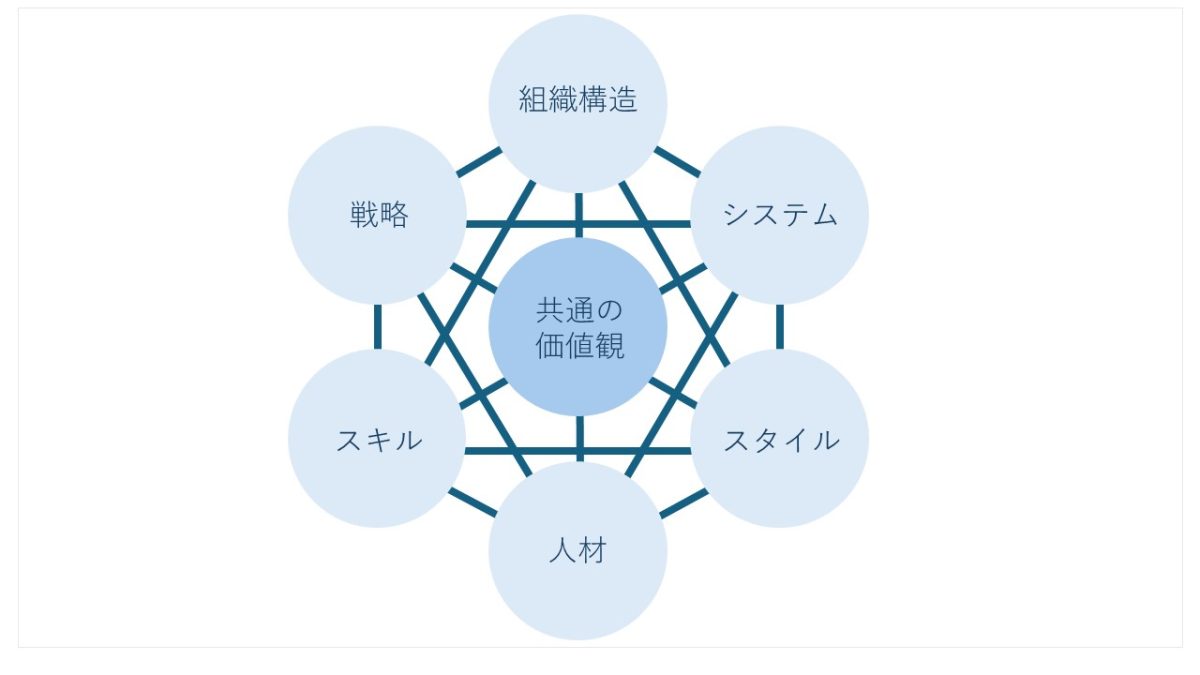
By analyzing how these elements influence one another, the framework evaluates the overall coherence of the organization and brings potential challenges to light.
\ 転職エージェントがご相談に乗ります /
The Three Hard Elements That Form the Organization’s Backbone (Hard 3S)

- Strategy: Business direction and competitive advantage
- Structure: Inter-departmental coordination and chain of command
- Systems: Business processes and evaluation frameworks
In McKinsey’s 7S, hard elements refer to the relatively changeable aspects that form the organizational backbone. Specifically, they consist of three elements: “Strategy,” which indicates the direction of the business; “Structure,” which defines the chain of command; and “Systems,” which governs business processes and institutional frameworks.
These can be changed in a planned manner through management decisions, and are positioned as a group of critical elements that constitute the basic framework of the organization.
Strategy: Business Direction and Competitive Advantage
Strategy refers to the specific policies and plans a company uses to achieve its set goals. It involves analyzing the market environment and competitor trends, and defining how the company will leverage its strengths to establish and sustain a competitive advantage.
Concretely, this encompasses everything from selecting the business domain — which markets to compete in, what products or services to offer, and which customers to target — to resource allocation plans.
All other elements of the organization must be aligned with the execution of this strategy.
Structure: Inter-Departmental Coordination and Chain of Command
Structure refers to the organizational mechanism that determines how roles, responsibilities, and authority are distributed among employees and how the chain of command is constructed to achieve the company’s objectives.
Specific examples include divisional structures, company structures, functional organizations, and matrix organizations.
For example, a flat organizational structure is appropriate for businesses that require rapid decision-making, while a functional organization is effective for deepening specialization.
Choosing the structure that enables the most efficient and effective information flow and collaboration for executing the strategy is required.
Systems: Business Processes and Evaluation Frameworks
Systems is a collective term for the formal and informal rules and processes used to run the organization.
This includes personnel evaluation systems, compensation systems, management by objectives frameworks, budget management mechanisms, information-sharing systems, and meeting management methods.
These systems play the role of guiding employee behavior and supporting the smooth progression of daily operations. By building systems that are linked to the strategy and organizational structure, the overall performance of the organization can be maximized.
\ 30秒で完了! /
The Four Soft Elements That Shape Organizational Culture (Soft 4S)

- Skills: The unique strengths possessed by the organization as a whole
- Staff: Employee capabilities and development policies
- Style: Leadership of management and organizational culture
- Shared Values: The central philosophy and vision of the organization
Soft elements refer to the less visible and more abstract aspects of an organization, such as its culture and climate. These consist of four elements — “Skills,” “Staff,” “Style,” and “Shared Values” — and, in contrast to hard elements, are characterized by the fact that they are formed over time and are difficult to change intentionally.
However, as they are deeply connected to organizational identity and employee motivation, they are an indispensable group of elements for sustainable growth.
Skills: The Unique Strengths Possessed by the Organization as a Whole
Skills refers not just to individual abilities, but to the capabilities possessed by the organization as a whole that serve as a source of competitive advantage. This includes specific technical capabilities, outstanding marketing abilities, advanced sales capabilities, or efficient production management skills.
These are the organization’s unique strengths that competitors cannot easily replicate, and can be described as the core capabilities for executing the strategy.
Correctly identifying the organization’s skills and further strengthening them is the key to sustainable growth.
Staff: Employee Capabilities and Development Policies
Staff is an element that comprehensively captures the capabilities, experience, expertise, values, and motivation of each individual employee in the organization. This also includes the human resource management policies regarding what kind of talent the organization seeks, and how it recruits, develops, and places employees in the right roles.
To realize a company’s strategy, talented individuals with the ability and motivation to execute it are indispensable, making it important to develop an environment that promotes employee growth.
Style: Leadership of Management and Organizational Culture
Style refers to the approach to leadership and decision-making tendencies of top management and managers, as well as the overall culture and climate of the organization formed through these.
For example, this includes organizational behavior patterns such as whether a top-down culture or a bottom-up culture that respects frontline opinions prevails, or whether the organization prioritizes teamwork or enforces a results-based meritocracy.
This style exerts a major influence on employee behavior and thought patterns.
Shared Values: The Central Philosophy and Vision of the Organization
Shared Values is the most important element, positioned at the center of the 7S model. This refers to the corporate philosophy, vision, and behavioral guidelines shared by the members of the organization, and represents the very reason for the organization’s existence.
All other six elements are required to be aligned with these shared values.
They serve as the basis for judgments about what direction the organization should head and what it should value, playing the role of strengthening the centripetal force among employees.
Three Benefits of Using McKinsey’s 7S

Using McKinsey’s 7S for organizational analysis offers many advantages.
This framework not only comprehensively visualizes the current state of the organization, but by focusing on the relationships between each element, it enables issue discovery at a deeper level. As a result, a vague sense of problems connects to concrete improvement actions, providing clear guidance for realizing effective organizational reform.
Objectively Grasp the Current State of the Entire Organization
McKinsey’s 7S is a framework that comprehensively analyzes an organization from seven different angles. Using this multi-faceted perspective makes it possible to shed light on aspects of the organization that are not normally noticed, and to objectively grasp the overall situation.
Because it evaluates even soft aspects such as organizational culture and employee skills that are not visible through numerical data alone like financial statements, it leads to a more accurate understanding of the company’s strengths and weaknesses, and prevents judgment errors caused by preconceptions or biased perspectives.
Verify Alignment Between Elements and Identify Issues More Easily
The seven elements are not independent of each other; they are strongly interrelated. By utilizing this framework, the alignment, contradictions, and inconsistencies between each element can be systematically checked.
For example, it becomes easier to discover problems such as an outdated personnel evaluation system (Systems) remaining in place despite an advanced strategy being pursued, or an organizational structure (Structure) that hinders inter-departmental collaboration.
Such misalignments are often the root cause of declining organizational performance.
Clarify the Specific Direction for Organizational Reform
Once contradictions and issues within the organization are identified through 7S analysis, what needs to be done in organizational reform becomes concrete.
For example, if it becomes clear that a lack of “Staff” skills is the bottleneck for the business, specific countermeasures such as strengthening the training system (Systems) or hiring specialized talent (Staff) become apparent.
By linking issues and solutions to the seven elements, it becomes easier to build a shared understanding among stakeholders, and discussions toward reform proceed smoothly. This makes it possible to formulate an accurate action plan.
- What Is Critical Thinking? Useful Thinking Frameworks Explained
- What Is SWOT Analysis? A Clear Guide to How It Works and How to Use It
How to Conduct Organizational Analysis Using McKinsey’s 7S [4 Steps]

- Step 1: Map out the current state of your organization for each of the seven elements
- Step 2: Analyze the relationships between elements and identify contradictions
- Step 3: Define the ideal organizational state and formulate improvement measures
- Step 4: Execute improvement measures and regularly check progress
Putting McKinsey’s 7S into practice requires a systematic approach.
First, comprehensively grasp the current state, then identify contradictions and challenges between elements. Next, envision the ideal state to aim for, and formulate and execute a concrete plan to close the gap between the current and ideal states.
By proceeding through this series of processes step by step, thorough and effective organizational analysis and reform implementation become possible.
Step 1: Map Out the Current State of Your Organization for Each of the Seven Elements
The first step is to objectively and concretely document the current state of each of the seven elements based on factual information.
For Strategy, review the medium-term management plan; for Structure, refer to the organizational chart.
For Systems, review employment regulations and evaluation sheets; for Skills and Staff, collect information through employee questionnaires and surveys; for Style and Shared Values, gather information through interviews with management.
At this stage, focus solely on grasping the current state as it is, without mixing in evaluations or judgments.
Step 2: Analyze the Relationships Between Elements and Identify Contradictions
Next, compare the information gathered for the seven elements and check whether there are relationships, contradictions, or inconsistencies between them.
For example, verify whether a personnel evaluation system (Systems) based solely on achievement of sales targets remains in place despite proclaiming a “customer-first” philosophy (Shared Values).
Also, by combining multiple elements for analysis — such as whether the organizational structure or decision-making process (Style) premised on existing business is hampering the promotion of new business (Strategy) — the fundamental challenges facing the organization become clear.
Step 3: Define the Ideal Organizational State and Formulate Improvement Measures
To resolve the challenges discovered in Step 2, first concretely define the ideal organizational state your company should aim for (To-Be model) in terms of the seven elements.
For example: “Foster a more challenging organizational culture (Style)” or “Introduce a new information system (Systems) that promotes cross-departmental collaboration.” Then, clearly identify the gap between the current state (As-Is model) and the ideal state, and formulate specific improvement measures to close that gap.
Create an action plan that clearly specifies who will do what, and by when.
Step 4: Execute Improvement Measures and Regularly Check Progress
In the final step, put the formulated improvement measures into action.
Since organizational reform is not something completed all at once, it is essential to regularly monitor the progress and effectiveness of the plan while executing it.
Set KPIs (Key Performance Indicators) and objectively evaluate whether things are proceeding as planned and whether the intended changes are occurring. If the expected results are not being achieved, analyze the causes and run a PDCA cycle that flexibly revises the plan, thereby increasing the probability of reform success.
Key Considerations When Using McKinsey’s 7S

While McKinsey’s 7S is a powerful tool for organizational analysis, there are several points to keep in mind to maximize its effectiveness.
In particular, understanding the importance of “Shared Values” as the foundation of the analysis, the perspective of linking hard and soft elements that differ in difficulty of change, and the need to ensure objectivity in the analysis are indispensable to avoid a superficial analysis.
Always Be Mindful of Alignment with the Central “Shared Values”
In the 7S model, “Shared Values” is positioned at the center and serves as the foundation for all other six elements.
Therefore, when considering specific measures such as strategy formulation, organizational structure changes, or system introduction, it is always necessary to verify that they are aligned with the company’s corporate philosophy and vision.
If this central axis wavers, the individual measures will lose consistency, and the entire organization will lose sight of the direction it should be heading.
It is important to recognize that all organizational reforms are undertaken in order to realize these shared values.
Consider Linkage with Soft Elements, Not Just the Easily Changed Hard Elements
Hard elements such as organizational structure and systems can be changed in a relatively short period of time through management decisions. However, true organizational reform cannot be realized by this alone.
Even if a new system is introduced, if the soft elements such as employee skills, values, and organizational style do not keep pace, the reform will become a mere formality.
A perspective of how to transform the soft elements simultaneously with changes to the hard elements is indispensable, and taking measures that link both in balance is the key to success.
Analyze the Current State Based on Objective Data
When conducting a current state analysis using 7S, it is extremely important to do so based on objective data and facts, eliminating personal subjectivity and preconceptions as much as possible.
For example, by using quantitative data such as inter-departmental collaboration scores from employee satisfaction surveys and the number of cross-functional projects, rather than just a sensory recognition of a problem like “the organization has poor communication,” the severity and causes of the issue can be identified more accurately.
Analysis based on objective evidence is the foundation for gaining the agreement of stakeholders and deriving accurate solutions.
[Case Studies] Real-World Examples of McKinsey’s 7S in Corporate Use

McKinsey’s 7S is not limited to a theoretical framework; it is utilized in various phases of actual corporate management. Particularly during periods of major transformation such as business integration or expansion into new businesses, it functions as a compass for organizing the complex challenges an organization faces and finding the direction for resolution.
Here, we present two specific use cases and introduce how they led to the identification and resolution of organizational challenges.
Case Study 1: Using 7S to Integrate Organizational Cultures During a Business Merger
When two large companies underwent a business merger, the differences in organizational culture between the two companies became a major challenge. Using McKinsey’s 7S to analyze the current state of each company revealed a significant gap, particularly in “Style (decision-making processes)” and “Shared Values (corporate philosophy).”
Based on these analysis results, a new corporate philosophy was formulated that reconciled the values of both companies. Furthermore, to embody that philosophy, a personnel system (Systems) incorporating new behavioral guidelines into the evaluation criteria was introduced, and company-wide training was conducted.
This made it possible to foster a sense of organizational unity and smoothly advance the creation of synergies after the integration.
Case Study 2: Using 7S to Identify Organizational Challenges Accompanying Business Diversification
A certain manufacturer in a mature market decided to diversify into IT services in pursuit of growth. However, it could not shake off the ways of the existing manufacturing business, and the new business stagnated.
Upon conducting a 7S analysis, it became clear that while the quality management capabilities (Skills) cultivated in the manufacturing business were high, the agile development skills and marketing capabilities needed for the new business were lacking.
The cautious organizational culture (Style) that did not tolerate failure was also identified as a challenge. In response, the company strengthened mid-career hiring (Staff) of specialized talent and changed to an organizational structure (Structure) that granted significant authority to the new business division, creating an environment that encouraged challenge.
\ 転職エージェントがご相談に乗ります /
Frequently Asked Questions

- Are there any points to be careful about when conducting an analysis?
-
The key is to analyze based on “objective data.” Rather than relying solely on subjective impressions such as “somehow the communication feels poor,” using facts like scores from employee questionnaires, turnover rates, and the number of projects makes it possible to identify issues with greater credibility.
- When transforming an organization, is it wrong to only change the quick-win “Hard 3S”?
-
That alone is insufficient and can be a cause of failure. Even if you change the organizational chart and systems (hard elements), if employee awareness and skills (soft elements) do not keep up, the reform will become a mere formality. When changing hard elements, it is necessary to simultaneously consider what kind of talent development and mindset reform (soft elements) are required.
Summary
McKinsey’s 7S is a framework for systematically understanding an organization’s current challenges by analyzing it from seven management elements from multiple perspectives.
By examining how the Hard 3S (Strategy, Structure, Systems) and the Soft 4S (Skills, Staff, Style, Shared Values) are interrelated, it clarifies misalignments within the organization.
It is important to always place “Shared Values” at the center of the analysis and verify that the other six elements are aligned with it.
By utilizing this framework to take a balanced approach from both the more easily changed hard elements and the time-consuming soft elements, sustainable organizational transformation can be realized.


